Pilgrimage
Triyuginarayan Temple Travel Guide: Shiva-Parvati Wedding Place, Route & Best Time
Triyuginarayan is the Himalayan village where Hindu tradition places the wedding of Lord Shiva and Goddess Parvati. About 12 km by road from Sonprayag, the temple is known for its sacred fire, ancient kunds and unusual connection with marriage rituals. Here is how to reach it, when to visit and what to know before darshan.
Opening note
If you are travelling towards Kedarnath, it is quite possible to pass close to Triyuginarayan without ever seeing it. At Sonprayag, almost everyone's attention is pointed in one direction—towards Gaurikund and the long journey to Kedarnath. Triyuginarayan lies away from that movement, up another mountain road. The change becomes noticeable once you take the turn. Traffic begins to thin. The road climbs towards a smaller Garhwali village, and eventually the temple appears without the scale or commotion of a major Char Dham shrine.
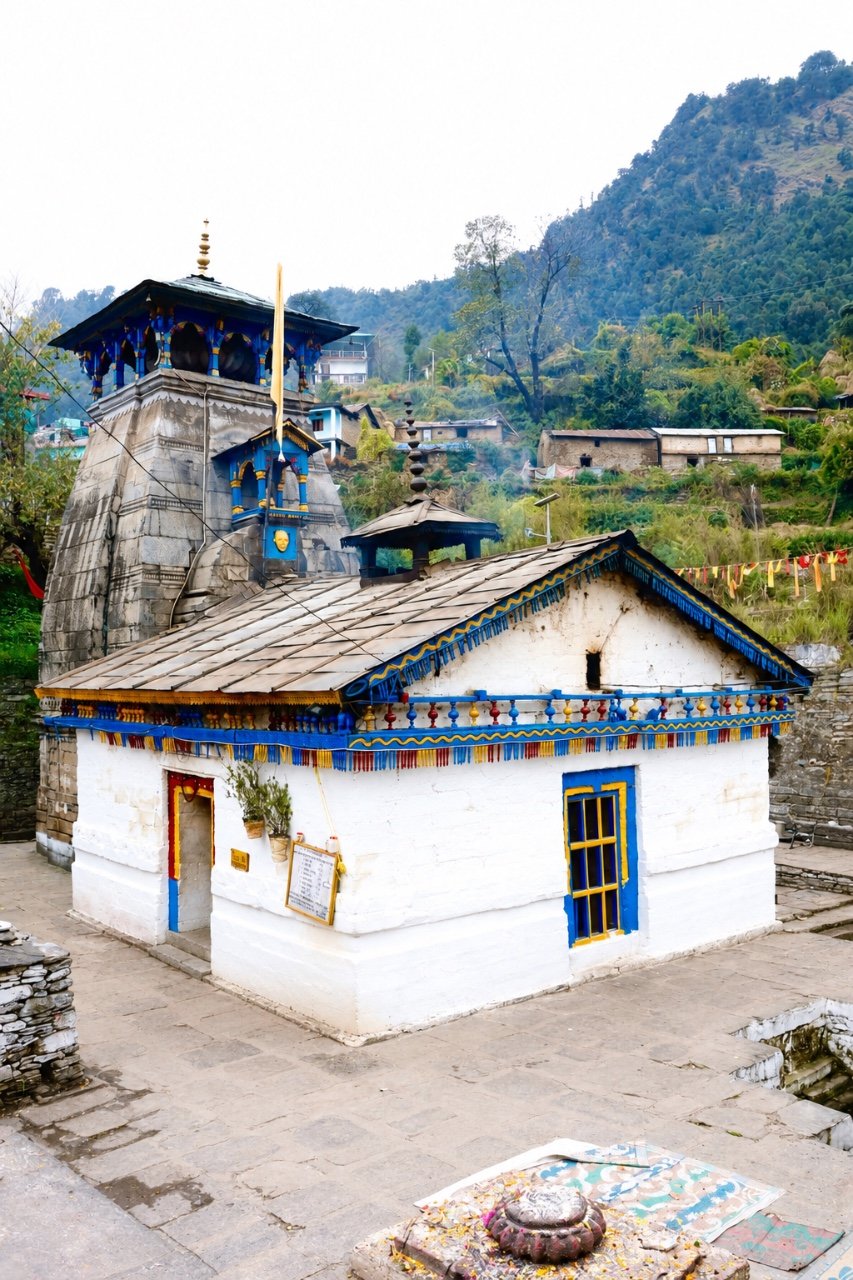
At first glance, it looks like an old Himalayan temple built from stone.
Then you notice the fire.
It burns in the courtyard in front of the temple, protected and tended rather than displayed dramatically. According to Hindu tradition, this is the Akhand Dhuni—the sacred fire associated with the marriage of Lord Shiva and Goddess Parvati at Triyuginarayan. That story is why many people come here. But what makes the place interesting is that the story has not been separated from everyday religious life. People still offer wood to the fire. Couples come seeking blessings. Weddings are conducted here. Pilgrims walk around the small courtyard while village life continues just outside.
Triyuginarayan does not require a long trek or a complicated pilgrimage plan. It asks for something simpler: Take the road away from the crowd, reach the village, and give the place enough time to tell you why people have remembered this wedding for generations.
Orientation
Know the place
Triyuginarayan Temple is located in Triyuginarayan village in Rudraprayag district, in the wider Kedarnath region of Uttarakhand. The village stands at an elevation of around 1,980 metres. One detail is especially important because it is often misunderstood: Triyuginarayan Temple is dedicated to Lord Vishnu, not Lord Shiva.
Its fame, however, comes from the Hindu tradition that identifies this as the place where Lord Shiva and Goddess Parvati were married. Lord Vishnu is associated with the marriage ceremony, while the sacred fire in front of the temple is believed to have been burning since that divine wedding. The fire is known as the Akhand Dhuni. In front of the temple is also the Brahma Shila, traditionally regarded as the place connected with the wedding ceremony. Within the sacred complex are the Rudra Kund, Vishnu Kund and Brahma Kund, with religious tradition linking their waters to the Saraswati Kund. The temple itself resembles the stone architectural tradition seen elsewhere in the Garhwal Himalayas. Inside, Lord Vishnu is worshipped as Narayana, accompanied by other deities. Triyuginarayan today is also becoming known as a place where couples choose to marry, drawing on the belief that Shiva and Parvati's own wedding took place here.
02 · Why it matters
More than a point on the map
There is an obvious reason people remember Triyuginarayan.
It is difficult to compete with a story involving the marriage of Shiva and Parvati. But if you arrive expecting a grand monument built around that story, the place may surprise you. The temple courtyard is relatively small. The village remains visible around it. Mountains form the background rather than being separated behind gates or landscaped grounds. And at the centre of everything is a fire. Not a sculpture of a fire.
Not a symbolic installation. An actual sacred flame that people continue to tend. Tradition holds that the Akhand Dhuni has continued from the fire lit for the wedding of Shiva and Parvati. Devotees offer wood into it, and some carry a little ash away as prasad. Whether you approach that belief through faith, mythology or cultural history, the continuity is what makes Triyuginarayan unusual. The story is not preserved only on a signboard. People still interact with it.
Then there are the kunds, the Brahma Shila, the Vishnu temple and the village itself. Together they make Triyuginarayan feel less like a single monument and more like a religious landscape built around one remembered event. That is also why the modern wedding connection does not feel entirely artificial. Couples are not coming here simply because the mountains provide a good photograph. They are choosing a place where, according to Hindu belief, one of the most important marriages in religious tradition took place.
04 · Plan
Plan smart, travel easy
How to reach
By road
The most useful reference point for reaching Triyuginarayan is Sonprayag. From Sonprayag, Triyuginarayan village is approximately 12 km by motorable mountain road. The road climbs away from the main Kedarnath pilgrimage corridor towards the village, so no mandatory trek is required for a normal visit to Triyuginarayan Temple. The final road from the Sonprayag side is a mountain road with bends and limited width in places. A distance of 12 km can therefore take considerably longer than the same distance in the plains.
If you are already staying at Guptkashi, Sitapur or Sonprayag, Triyuginarayan works well as a separate half-day visit.
By train
For most travellers, Rishikesh/Yog Nagari Rishikesh is the practical railway gateway for the Kedarnath–Rudraprayag region. From Rishikesh, continue by road through Devprayag, Srinagar, Rudraprayag and Guptkashi towards Sonprayag before taking the final road to Triyuginarayan. Do not plan to reach by train and complete the entire mountain journey on a tightly timed schedule. The road section is long, and Char Dham traffic, road work and weather can significantly change travel time.
By air
Jolly Grant Airport near Dehradun is the nearest major airport used for this part of Garhwal. From the airport, continue by road towards Rishikesh and then follow the Rudraprayag–Guptkashi–Sonprayag route. If arriving on an afternoon flight, staying at Rishikesh or somewhere further along the Garhwal route before continuing the next morning is usually more comfortable than attempting a late-night mountain drive.
Best time to visit
April to June
For most first-time visitors, this is one of the easiest periods for travelling to Triyuginarayan. The weather is generally more comfortable, daylight hours are longer and the wider Kedarnath region is fully active with pilgrims and travellers.
There is, however, an important trade-off. Once the Kedarnath Yatra season gathers momentum, traffic on the road through Guptkashi, Sitapur and Sonprayag can become heavy. Even though Triyuginarayan is away from the main Gaurikund route, you still share much of the approach journey with Kedarnath traffic. Start early.
July to August
The monsoon transforms the mountains around Triyuginarayan into deep green slopes, but this is the season requiring the most flexibility. Heavy rain in Rudraprayag district can affect road conditions, cause delays and increase the risk of landslides on mountain routes. A visit is possible when conditions are stable, but this is not the right season for an itinerary that depends on arriving at a precise hour. Check current weather and local road conditions before leaving.
September to November
For many travellers, this is the best overall period. Once the monsoon begins to withdraw, the landscape remains green while visibility generally improves. October in particular can offer crisp weather and clearer mountain views. The daytime conditions are comfortable for temple visits, while evenings become noticeably colder as the season progresses. This is also a particularly attractive period for couples considering a ceremony at Triyuginarayan because the weather is usually easier to manage than in peak monsoon or deep winter.
December to March
Winter gives Triyuginarayan an entirely different character.
Snow is possible, temperatures can fall sharply and fresh snowfall may temporarily affect the approach road. Do not assume that because the temple is considerably lower than Kedarnath, winter access will always be effortless. If you specifically want to see Triyuginarayan in snow, keep your dates flexible and confirm both road access and current temple arrangements locally before starting the final journey.
People & place
Food and local culture
Triyuginarayan is still a village before it is a destination. That is worth remembering when deciding what to expect from food and facilities. You will find simple local establishments and seasonal pilgrim-oriented food rather than the café culture that has developed around some better-known mountain destinations. For most visitors, a meal here will be straightforward—tea, paratha, dal, rice, roti, vegetables or whatever is being prepared locally that day. That simplicity suits the place. The more interesting cultural element is the relationship between the village and marriage. Triyuginarayan's identity has always been tied to the Shiva-Parvati wedding tradition, but in recent years that association has increasingly become part of actual wedding ceremonies. Couples now travel here specifically to marry in the sacred setting connected with the divine wedding. That creates an unusual situation for ordinary travellers. You may arrive for darshan and discover that a real wedding is taking place nearby. Treat it as somebody's religious and family ceremony —not as entertainment provided for visitors.
If photographs are appropriate, keep enough distance that the couple and their families do not have to negotiate around tourists while performing their rituals.
Before you leave
Plan with care
Useful notes
- Start early from Guptkashi, Sitapur or Sonprayag. The temple itself may be peaceful while the approach roads become considerably busier later in the day.
- Remember that Triyuginarayan is road-accessible. You do not need to complete the Kedarnath trek or walk from Gaurikund to visit it.
- Allow time for the Akhand Dhuni rather than treating it as a photograph stop. This is the central religious feature of the site.
- Look for the Brahma Shila and the sacred kunds. They are part of the Triyuginarayan tradition and easy to overlook if you focus only on the main temple.
- Carry an extra layer even during otherwise pleasant months. At roughly 1,980 metres, temperatures can change quickly once clouds arrive or the sun disappears.
- Keep footwear suitable for uneven stone surfaces and village lanes.
- Carry some cash. Do not assume every small business or local service will always have reliable digital connectivity.
- If travelling during Kedarnath Yatra season, add traffic buffer. Sonprayag is one of the busiest points on the Kedarnath pilgrimage route.
- If combining Triyuginarayan with Kedarnath, do not force both into the same exhausting schedule. A better plan is to visit Triyuginarayan either before beginning the Kedarnath trek or after returning and resting.
- Current government tourism information lists temple hours of approximately 7:00 AM–2:00 PM and 4:00 PM–8:00 PM, but treat these as reference timings rather than a permanent guarantee. Seasonal routines, ceremonies or local arrangements can change, so confirm if your journey depends on arriving near opening or closing time.
- If planning a wedding rather than a normal temple visit, contact the appropriate local temple/administrative authority separately. A travel visit and a marriage ceremony have completely different logistical requirements.
Things to avoid
- Do not describe Triyuginarayan as a Shiva temple simply because it is associated with Shiva's wedding. The principal temple is dedicated to Lord Vishnu.
- Do not interfere with the Akhand Dhuni. Follow the instructions of priests or temple staff regarding offerings, wood and ash.
- Do not assume the sacred fire is there for photography alone. Give devotees enough space to perform their rituals.
- Do not enter or use the sacred kunds casually without understanding the local religious practice.
- Avoid loud music in the village and temple area.
- Do not photograph weddings at close range without permission. A ceremony happening in a public religious setting does not automatically make it public content.
- Do not underestimate the Sonprayag–Triyuginarayan road because the distance is short. Mountain-road conditions, traffic and weather can substantially affect travel time.
- Avoid unnecessary travel during intense monsoon rain. Check current road advisories rather than relying solely on a route shown as open in a navigation app.
- In winter, do not proceed after fresh snowfall without checking the final road condition locally.
- Do not leave plastic bottles, food packets, wedding decorations or religious offerings around the temple or village.
07 · Make it yours
Suggested itinerary
Day 1 – Guptkashi/Sonprayag to Triyuginarayan: Stay the previous night around Guptkashi, Sitapur or Sonprayag and leave after an early breakfast. Take the mountain road towards Triyuginarayan and reach the village before the busier part of the day. Visit the main Vishnu temple first, then spend time around the Akhand Dhuni. See the Brahma Shila and the sacred kunds without rushing from one point to another. Walk briefly through the surrounding village, have a simple local meal or tea, and return towards Sonprayag or Guptkashi while there is still plenty of daylight. If your next journey is to Kedarnath, keep the evening for rest rather than beginning another demanding section of the pilgrimage immediately.
A final note
Most famous wedding places are remembered because of the people who married there. Triyuginarayan works the other way around. People come here because of a wedding they believe happened long before any road reached the village. That story could easily have become nothing more than mythology repeated by guides. Instead, there is still a fire. People still gather around it. Couples still come here to begin their own marriages. And the old stone temple continues to stand above a Garhwali village where everyday life carries on around all of this history and belief. Perhaps that is why Triyuginarayan feels more meaningful when you do not try too hard to make it dramatic.
Stand near the courtyard. Watch someone place another piece of wood into the Dhuni. Look at the mountains beyond the village. Then consider how many generations must have stood in roughly the same place and repeated the same story. The fire itself is small. The memory attached to it is not.
No approved comments yet. Be the first to share your thoughts.